
How to Get Backlinks for AI Products: Six Steps
Learn how to get backlinks for your AI product with six steps, a link quality check, outreach benchmarks and the link spam risks to avoid.
By Free AI Directories Team · November 18, 2026
A backlink is not a ranking switch. That's the first thing to unlearn. Most advice aimed at AI and SaaS founders treats links as a lever: buy the placements, watch the rankings move. Founders follow it, submit to a few hundred directories, and then can't explain why signups stayed flat.
A narrower model works better. Judge every link on three things: whether the page is relevant to what the product does, whether real readers ever visit it, and what the link attribute says about how it counts. Anything that fails those checks is work nobody needed to do. The rest of this guide is about applying that filter without wasting a quarter on it.
Table of Contents
- Why Backlinks Matter for an AI Product
- Which Link Sources Are Worth Your Time
- How to Earn Backlinks in Six Steps
- Outreach Numbers and What to Do When Replies Stay Low
- Earning Links Without a Newsworthy Campaign
- Using Directories Without Spam Risk
- Audit Your Backlink Profile Before You Scale
Why Backlinks Matter for an AI Product
Start with what a link does, because the honest answer shapes the plan. Google's systems use links to understand how pages relate to one another and to identify which pages may be useful, and PageRank, one of its original core ranking systems, has used links since Google launched, as Google's ranking systems guide sets out.
That splits the job in two. First, discovery: Google mainly finds pages by following links from pages it has already crawled, and the vast majority of new pages it finds each day are discovered through links. Second, context: a link from a page about the same problem your tool solves says something a link from a general web directory can't.
The limit matters as much as the effect. Links are not a guaranteed ranking shortcut. The same documentation places them inside a broader system that also weighs useful content, alignment with search intent, technical access and the credibility of the site itself.
For a product with a few weeks of history, the first goal isn't a count of referring domains. It's making sure the right buyers and the crawlers that serve them can reach the product page and understand what it does. A handful of relevant links from sites your buyers read usually beats dozens from sites nobody visits, and that trade-off runs through everything below: the workflow, how to judge each link, the outreach numbers to expect, the directory rules that keep a listing from tipping into spam, and the audit to run before scaling any of it.
Which Link Sources Are Worth Your Time
Eight sources cover nearly everything an AI founder gets offered. They aren't equal, and each has its own failure mode.
| Link source | Typical example | What it is worth | Main risk |
|---|---|---|---|
| Editorial mention | A writer links to your tool while covering the problem it solves | High when the page is relevant and read | Hard to earn on demand; needs something worth citing |
| Partner or integration page | A tool you integrate with lists your product on its partner page | Relevant, with a real referral path | Reciprocal arrangements that look like a swap |
| Niche resource page | A maintained list of tools for one specific job | Relevant when the page is current and crawlable | Old or dead pages that no longer send readers |
| Industry association or community listing | A category listing run for a specific professional group | Moderate; depends on traffic and category fit | Bulk listings with no reader value |
| General AI tool directory | Listing in an open directory of AI products | Mainly discovery and referral; ranking value is unproven | Low-quality or paid placements presented as editorial |
| Sponsored placement | A paid ad or featured spot | Exposure and referral visits; no ranking credit should be expected | Must carry a sponsored or nofollow attribute |
| Reciprocal link exchange | Two sites agree to link to each other | Little value when done at scale | Excessive exchanges count as link spam |
| Automated or bulk placement | Software creates links across many unrelated sites | None worth pursuing | Classed as link spam |
The editorial test
Ask one question before adding a site to a target list. Would a human editor or author link to this page if nobody had asked? If the answer needs a paragraph of justification, the link is being manufactured rather than earned, and manufactured links are the ones that get devalued or ignored.
A page that answers one job for one audience is far easier to place than a general list. Think of a specialist resource such as AI for executive search firms: narrow audience, clear job, and any publisher linking to it knows exactly which readers it serves. That's the shape of page worth pitching.
Judging a link beyond its metrics
A single score can't tell you whether a placement will do anything. Review it on topical relevance, whether the page pulls real organic or referral traffic, the editorial context around the link, the quality of other outbound links on that page, whether the page is indexed, the link attribute, and whether the destination helps a reader.
Industry habits lean hard on scores anyway. Survey evidence reported by Reporter Outreach found that 62% of SEO professionals prioritize link quality over quantity, while 91% apply a minimum domain-rating threshold and 41% require DR 50 or higher, all self-reported perceptions. Google's own guidance doesn't recommend any third-party authority score. It emphasizes crawlable HTML links, natural anchor text and avoiding keyword stuffing.
The contrarian reading holds up. A lower-metric site with real readers and editorial standards is often the better target than a high-scoring site that sells links openly. Volume proves nothing either: a study of almost 1 billion web pages by Ahrefs found more than 30,000 pages with backlinks from over 200 distinct referring domains that received no organic search traffic at all, which is what happens when links are weak or the page targets something nobody searches for.
If a buyer would be confused or unimpressed to see the link, skip it.
How to Earn Backlinks in Six Steps
The process below is deliberately unglamorous. It exists so that every hour of pitching has a reason behind it, and so that a failed campaign can be diagnosed instead of abandoned.
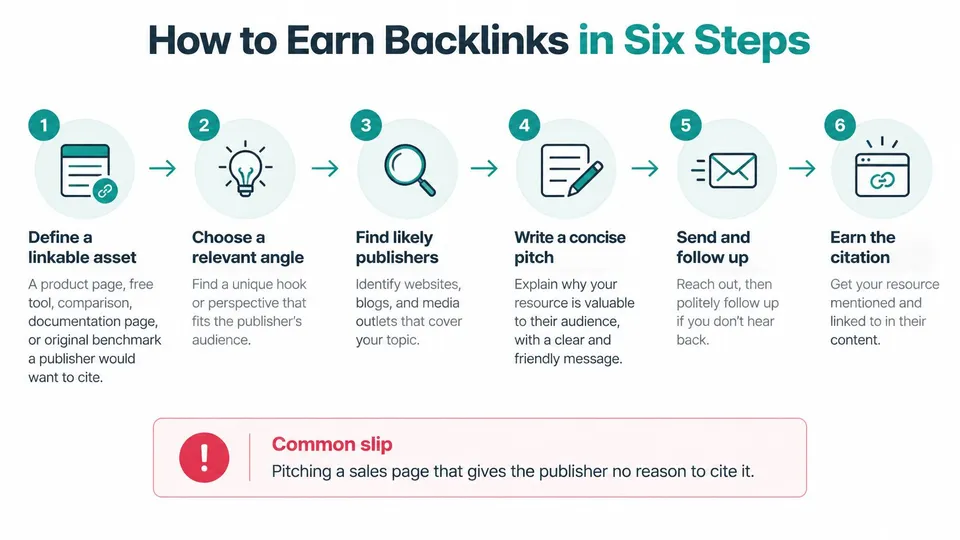
- Define a linkable asset. A product page, free tool, honest comparison, documentation page or benchmark a publisher would want to cite. The common slip is pitching a sales page that gives the reader nothing new, which is the single fastest way to get ignored.
- Identify topically relevant sites. Search for the pages your buyers already use, such as "best AI tools for [task]" or "AI tools for [job]", then open the top results and check whether they list tools like yours, whether the page is current and whether the publisher has real readers. The slip here is choosing targets by domain rating alone, which produces a list of sites whose audience will never buy. Niches reward this discipline: a trade-facing guide on word-of-mouth growth for tattoo studios is linkable inside that trade because it answers a question the trade asks, and a generic marketing post isn't.
- Verify each target before writing. Confirm the page is live and indexed, the site has readers, the contact belongs to the editor or author, and the page fits your product. Sending to a generic inbox is the most common slip, and it usually means the message is never read.
- Personalize around one benefit. Name the page you want to join and the specific reason its audience gains from your inclusion. A template with only the name swapped is the slip, and editors recognise it within a sentence.
- Send one measured follow-up. If there's no reply after a reasonable wait, send a single short reminder, then stop. Repeated reminders burn the contact and the domain.
- Record every result. Response, placement, target URL, anchor text, link attribute. Without a log you can't tell which target list worked, and the next cycle starts from zero.
A finished first cycle looks small: a short target list, a handful of verified contacts, and a log ready for review. That's the point. The evaluation rules above decide who stays on the list.
Outreach Numbers and What to Do When Replies Stay Low
Set expectations before sending anything. Backlinko's analysis of 12 million outreach emails found that only 8.5% received any response, which means a campaign of 1,000 messages would statistically produce about 85 replies before a single one is qualified or placed.
Treat this as a planning baseline.
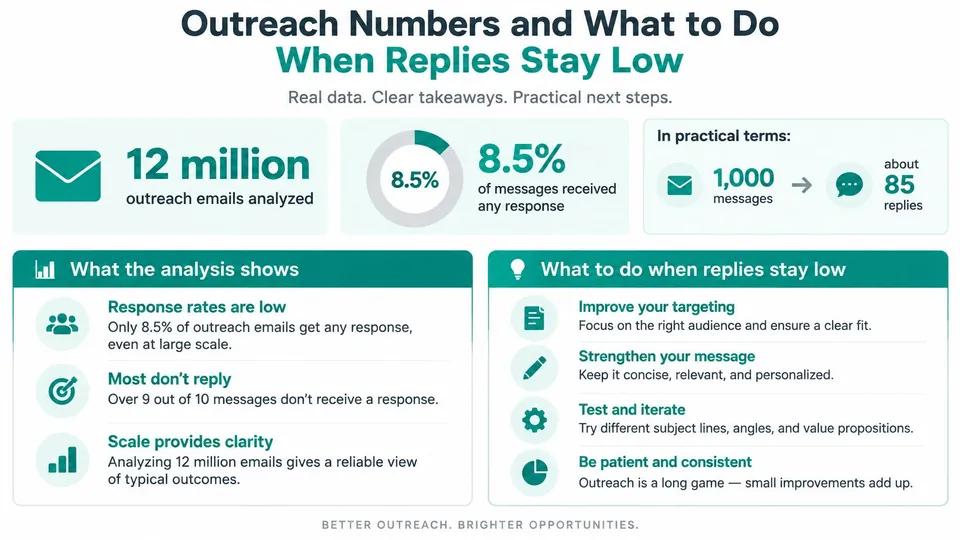
The same study found something more useful than the headline rate. Contacting several relevant people at one organization produced a 93% higher response rate than contacting one person, and a follow-up message also raised response rates. Both findings point the same way: a pitch that reaches a real editor through a real route outperforms a bigger send.
Replies stay directional: relevance, the strength of the asset, the publisher's editorial standards and the accuracy of the contact details dominate the outcome far more than volume does.
When replies stay low, work through the causes in a fixed order rather than guessing.
- Targeting first. A high-DR page whose readers will never buy the product wastes every pitch sent to it, and no rewrite rescues a bad list.
- The opening line second. Rewrite it around one benefit for that specific audience, not the product's feature set.
- The asset third. If the page offers a publisher nothing to cite, the offer is the problem, and the reply rate will stay flat no matter who reads it.
- Contact details fourth. A named editor beats a shared inbox every time.
- Send time last. It is the smallest variable and the one people tinker with first.
After a reply arrives, thank the person, answer their question in the same thread, confirm the page and the anchor text, and log the outcome. The trade-off nobody mentions is time: personalization costs more per pitch, so a smaller, better list usually produces more placements per hour than a large batch sent from a template. If a cleaned list and a repaired asset still produce silence, I'd stop sending rather than push another batch. A paused week protects the domain, and a dead list teaches nothing the second time around.
Earning Links Without a Newsworthy Campaign
Digital PR works when there's a story with evidence behind it and a moment to tell it. Most small teams can't manufacture one every quarter, and the pitch collapses when the "original data" is a survey of a dozen users.
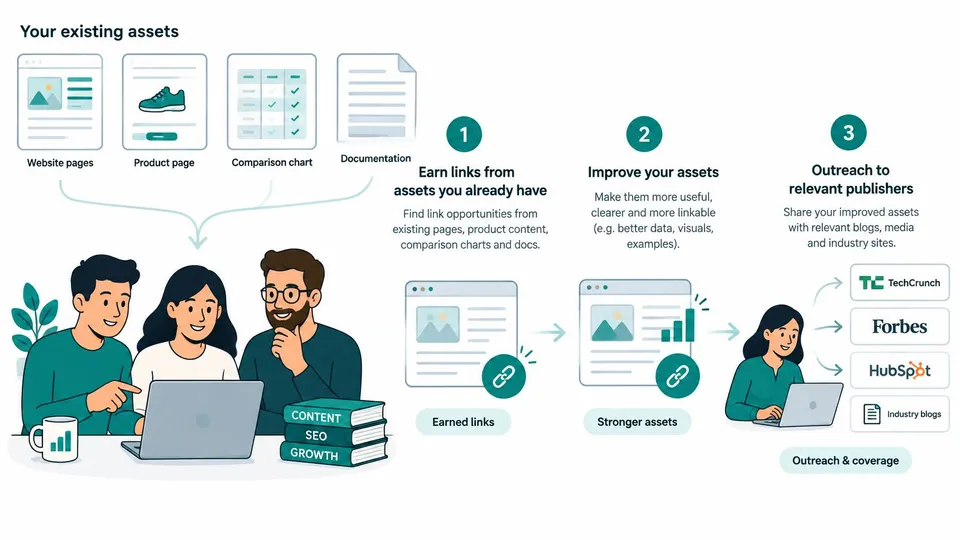
The workable path is staged. Earn links first from assets already sitting on the site: documentation that solves a real setup problem, a benchmark you measured, open-source code or a small utility, expert commentary on a shift inside your category, integration partners and niche resource pages. Move to journalist outreach only when the evidence has a clear audience and a timely angle. If the asset is the product itself, this overlaps with how to promote an app after launch, because both depend on getting the product page in front of people who have the problem.
The three questions founders ask
What can a solo founder pitch without inventing research? A working tool, a how-to built from real screenshots of the product, a dataset exported from your own product with its limits stated, or a clear point of view on something changing that you can describe from the inside. None of that needs a survey.
How many personalized pitches are realistic? No research fixes a number. Pick a weekly count you can personalize without recycling yesterday's email, watch the reply rate, and change the count when the rate moves.
What should happen after rejection? Log it with the date and any stated reason. Don't argue, and don't re-pitch the same angle. A different angle months later is fair. A reminder the following week isn't.
The survey picture explains why this staged approach beats a generic push. A 2025 survey reported by BuzzStream found that 66% of link builders struggled to identify effective tactics, only 29% considered their link-building efforts successful, and 68% used a spontaneous rather than planned approach. The same reporting picked digital PR as the best-performing tactic for 34% of respondents, against 18% for guest posting, though those are self-reported perceptions rather than proof that any particular business should lead with PR.
Scaled, generic placements are the riskier route. Google treats links created mainly to manipulate rankings, including buying or selling links for ranking purposes, as link spam. A small set of relevant, earned links and referral relationships is slower and considerably more durable than a bought footprint.
Using Directories Without Spam Risk
Directories are where early-stage AI founders usually start building links, and where they usually overdo it. Moz's directory guidance recommends choosing directories carefully rather than submitting to every one available, and suggests a 2:1 proportion: one natural link for roughly every two directory links. Moz presents that as a practical benchmark, and it works as a concrete way to keep submissions in proportion.
Three checks before any submission.
- Where the link lands. Confirm the category fits the product itself. A directory about AI in general can still file your tool in the wrong section.
- Whether the page is indexed. Check that the target page shows up in Google before spending time on the form.
- Whether it can send qualified visitors. A directory read by people who might try the tool outweighs one with a bigger domain rating.
Then write a description written for that directory instead of pasting the same block into every form, and make sure the listing page is crawlable and reads like a real product page. Google's advice to site owners is to link only to resources they trust and annotate the ones they can't vouch for. An operator who follows that standard runs a directory worth appearing in.
Treat this as a sanity check: the 2:1 proportion gauges balance. No single listing promises rankings or traffic.
Keep the list short and hand-picked. Consistent, crawlable listings across several relevant sites are a reasonable bet, provided you judge each one by relevance, real readers and the link attribute it gives you. Free AI Directories maintains lists of AI directories, including free, high-DR and dofollow selections, and its submissions are manual and white-hat only, with no bots, no autofill and no spammy links. If you'd rather handle it yourself, this comparison of free directory submission tools is worth reading before paying for anything. And if a directory fails the checks, skipping it costs you nothing.
The honest trade-off is time. Every form costs minutes, and a handful of checked listings beats a bulk blast. Google's spam policies name low-quality directory or bookmark site links as a form of link spam, so those three checks are the line between a useful listing and a risky one.
Audit Your Backlink Profile Before You Scale
A profile built on unrelated, automated or exchanged links can cost trust even while it looks impressive in a dashboard. Run the checks before increasing volume.
| Audit signal | Where to check | Action if found |
|---|---|---|
| Referring domains unrelated to your product | Search Console links report or a third-party crawler | Review each domain and remove or disavow links you placed or can trace |
| Sudden concentration of one exact-match anchor | Anchor text report in Search Console or a crawler | Request branded or descriptive anchors where you can |
| Linking pages that are deindexed or return errors | Index coverage report and a site crawler | Fix or replace the target URL and update the record |
| Sharp spike in new links over a short period | Link history in a third-party tool | Check the source of each new link before any further outreach |
Then document every link as editorial, user-generated, sponsored or nofollow. Reject automated networks, paid links meant to pass ranking credit, excessive reciprocal exchanges and bulk low-quality directory placements. Google's link scheme guidance names buying or selling links for ranking purposes, automated link creation, excessive exchanges and optimised links in paid or distributed content as link spam, and asks that paid or sponsored links carry rel="sponsored" or rel="nofollow".
The pitfall is treating directory count or a domain-rating number as equivalent to SEO value. A link can be crawled yet ignored, devalued or harmful to trust if it exists mainly to manipulate rankings. Measure qualified referral sessions, indexed target pages, branded-search lift and relevant referring domains instead, and if you want what domain rating actually measures in plain terms, read it before optimising for it.
On help: do the work yourself when you can personalize each listing and want full control of the record. If you pay for submissions, expect a report listing what was submitted rather than guaranteed live links, because approval and indexing take time. Free AI Directories states plainly that it does not guarantee specific Domain Rating increases, rankings, traffic or revenue, which is a realistic position for any service.
Pick five relevant targets this week, verify them, log each result, and send nothing until that list exists.
Free AI Directories keeps a searchable database of AI directories with domain ratings, dofollow status and free-versus-paid information, so you can check today's data instead of trusting an old spreadsheet. Start with a free listing, or let the team handle the forms starting from $99 at Free AI Directories while you spend the saved hours on the content that earns the links worth having.
Ready to list your AI tool?
Get your tool in front of users across hundreds of AI directories.
Submit Your Tool →