
Domain Rating Checker: How to Read Your Score
Use a domain rating checker to look up any site's DR, read the 0-100 score correctly, and see what it cannot prove about rankings.
By Free AI Directories Team · November 23, 2026
A high number from a domain rating checker looks like a grade. Does that grade tell you a site will rank, get cited in an AI answer, or send you buyers?
It doesn't. The score is a screening tool for backlink strength. Founders of AI tools and SaaS products still need links, mentions, and users, but the number only helps you sort prospects and watch a trend. It doesn't prove relevance, crawlability, traffic, or visibility in AI answers. Read it with a date, a property name, and a short check of the links behind it.
Table of Contents
- How to Check a Domain Rating in Four Steps
- Reading the 0-100 Score Without Overrating It
- Domain Rating Compared With Other Authority Scores
- Verifying Referring Domains Behind the Number
- Spotting Risky Links That Inflate a Strong Score
- What a Domain Rating Cannot Tell You About AI Visibility
- Decide Which Links Deserve Your Time
How to Check a Domain Rating in Four Steps
Most lookups fail before the number is even useful, because nobody writes down what was checked. A domain rating checker returns a score for the property you type in. If you mix a homepage URL, a subdomain, and a root domain across a week of research, you can't compare the results.
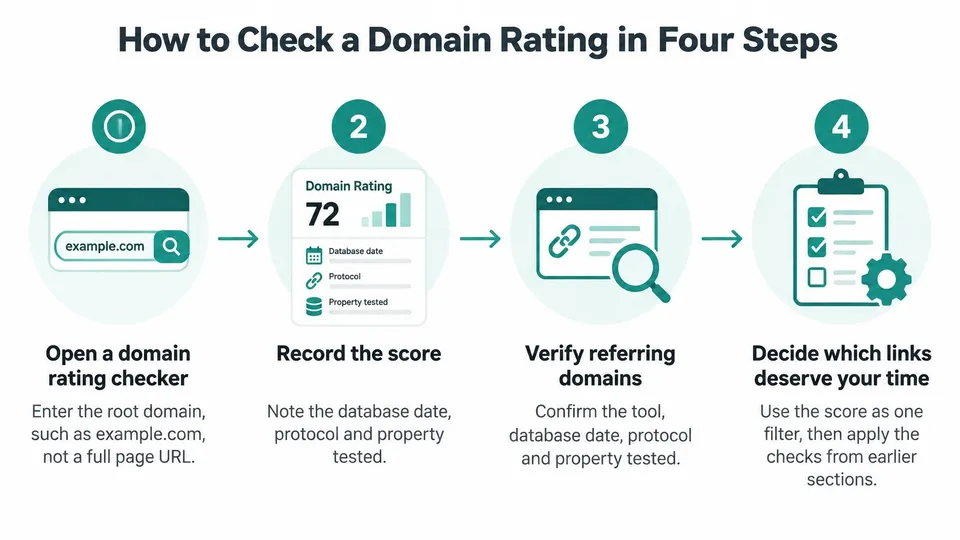
Run the lookup the same way every time
- Open a domain rating checker and enter the root domain. Type something like example.com, not a full page URL. A root-domain lookup covers the whole site. A page URL can pull a different property, and then the score isn't about the site you meant to judge.
- Note the tool name, the database date, and the exact property. Scores move when an index refreshes, even if you didn't earn a new link. Free checkers don't all refresh on the same schedule, so don't treat the figure as a live reading. Write the protocol too, because http and https can be stored as different properties.
- Record the score and the referring-domain count if the tool shows it. The score alone is a summary. The count beside it tells you whether that summary rests on many linking sites or a thin set. Keep both numbers in the same row.
- Repeat the lookup for each competitor or prospect in the same tool, on the same day. Two tools can show different values for the same site, because each one crawls its own link graph. A subdomain can also carry a different score from its root domain. Same-day, same-tool numbers are the only ones you can line up.
What a usable record looks like
A usable result is one score, a date, and a clear note of which domain was checked. Say a founder looks up a docs subdomain in the morning and the marketing root domain in the afternoon, then compares those two figures to a rival checked last month in another tool. That comparison is noise.
Practical rule: One row should read like this: tool name, database date, root domain, score, referring domains. If any of those fields is blank, run the lookup again before you decide who to contact.
Reading the 0-100 Score Without Overrating It
Domain Rating (DR) is an Ahrefs estimate of backlink strength, and nothing else. It places sites on a logarithmic scale from 0 to 100, where 100 marks the strongest link profiles in the index, according to Ahrefs' explanation of Domain Rating.
That logarithmic shape matters when you compare scores. Each point takes more modeled link strength than the point before it. Moving from 20 to 30 is a modest climb; moving from 60 to 70 is a steep one. Near the top of the scale, a gap of a few points can represent a much larger difference in the links behind the score.
What the model actually counts
Ahrefs starts with the domains that hold at least one followed link to the target. For each linking domain, it counts how many other unique sites that domain links out to, then passes a share of the linking domain's rating across those destinations. Distribution matters most here. A site that links to thousands of destinations passes a thin slice of its rating to each one, while a site that links out rarely passes a thicker slice. One link from a selective high-DR site can outweigh a stack of links from sites that link to everything.
The score rolls up to the whole domain, so a strong DR can sit on top of weak individual pages. It leaves out traffic, domain age, and content quality, and it says nothing about whether Google crawls the site, whether its pages rank, or whether an AI assistant will ever cite it.
Two sites, one score band
Two AI writing tools both check in at the same DR. The first earned its links from niche blogs its buyers already read. The second collected links from broad roundup lists that cover every software category. Same band, different profile. The score cannot show which one sends qualified visitors. You still have to open the linking pages.
Can a high DR make up for irrelevant links? No. A strong score can rest on links from unrelated sites. Check topical fit before you treat the number as a reason to pursue the link.
Does a low score mean a new site can't rank? No. DR measures backlink strength only. A new product site with few links can still rank for queries where the page matches what the searcher wants.
DR works like a resume screen: it decides which sites earn a closer look. Rankings, traffic, and relevance each need their own check.
Domain Rating Compared With Other Authority Scores
These scores get swapped in conversation as if they were the same grade. They aren't. Each one comes from a different owner, a different crawl, and a different scope.
| Metric | Owner | Scale | Scope | Status |
|---|---|---|---|---|
| Domain Rating (DR) | Ahrefs | 0-100, logarithmic | Whole domain | Active vendor score based on Ahrefs backlink index |
| URL Rating (UR) | Ahrefs | 0-100, logarithmic | Single page | Active vendor score |
| Domain Authority (DA) | Moz | Separate score (a DA of 50 isn't a DR of 50) | Whole domain | Active vendor score that includes Spam Score |
| PageRank | 0-10, logarithmic (Toolbar) | Single page | Public score stopped updating in 2013 and removed from Toolbar in 2016 |
What each score is for
Domain Rating summarizes followed links to a whole domain inside Ahrefs' index. URL Rating applies a similar link model to one page, so a strong domain can still have a weak article, and a single strong page doesn't rewrite the domain score.
Domain Authority is Moz's whole-domain score. Its model isn't only a link count. Moz includes Spam Score, link-quality distributions, and traffic-related distributions, so a DA reading is answering a wider question than DR.
PageRank is the older public idea behind these checkers. Larry Page and Sergey Brin treated links as votes while at Stanford in the 1996–1998 period. The patent, "Method for node ranking in a linked database," was filed on January 9, 1998, and Google launched publicly in September 1998. Around 2000, the Toolbar showed PageRank on a 0–10 logarithmic scale. Google stopped publicly updating Toolbar PageRank in 2013 and removed it from the Toolbar in 2016, as Patrick Stox's PageRank history explains. You can't look up a public PageRank anymore. Modern checkers are independent approximations of modeled link strength, not an official Google ranking score.
Why the numbers don't convert
In 2024, Ahrefs Domain Rating had a 0.89 correlation with Moz Domain Authority, according to RankTracker. The two scores tend to move together. They still aren't interchangeable. A DR of 50 isn't the same as a DA of 50, because the indexes, formulas, and normalization differ.
Pick one metric for a project and use it for every comparison in that project. Mixing DR on Monday with DA on Friday makes a prospect list look precise when it isn't.
Verifying Referring Domains Behind the Number
The row you saved during the lookup is the start of the audit. The number summarizes the link profile without showing which domains sit behind it. The formula and the crawl coverage aren't fully public, so the displayed figure deserves verification before you act on it.
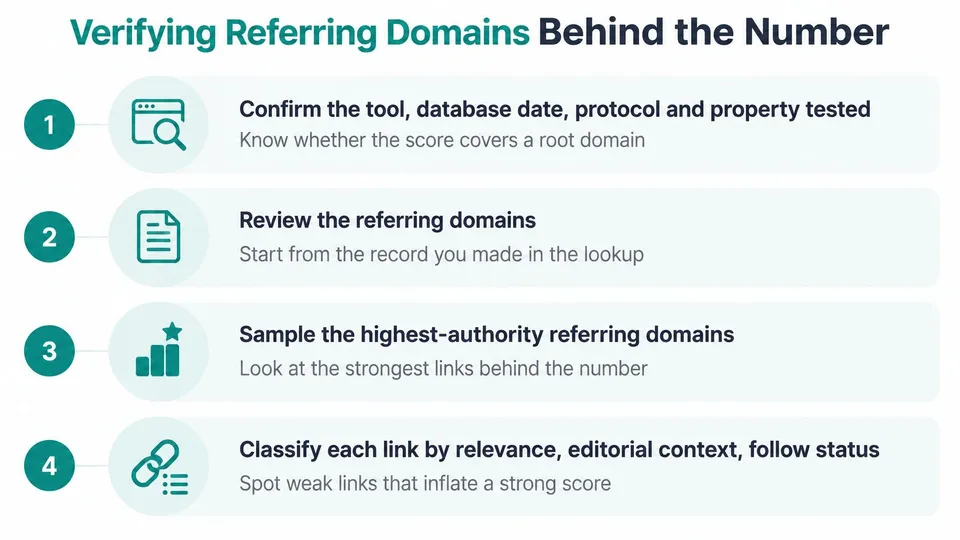
Five checks before you trust the figure
- Confirm the tool, database date, protocol, and property. You need to know whether the score covers a root domain, a subdomain, or a single URL. A mismatch here makes every later check about the wrong site.
- Export unique referring domains, not total backlinks. Repeated links from one site count once for the referring-domain tally. A long backlink export can look busy while the unique-domain list is short.
- Confirm at least one followed link from each important referring domain. Nofollow links don't improve the score. A directory or blog that only points with nofollow can still send a visitor, but it isn't what moved the metric.
- Inspect the linking site's own authority and how many unique domains it links to. A site that links out to a huge list passes less value to each destination in this model. Open a sample of those pages instead of trusting the domain name.
- Compare only inside the same tool and the same time window. Scores can change when the index refreshes, or when linking domains gain or lose authority, even if you didn't acquire a new link.
The practical difference is large. A campaign that adds 100 links from five domains can produce a much weaker signal than five links from five distinct, reputable domains. Chasing volume from the same handful of sites is a weak way to build the profile this metric rewards. If you want a calmer plan for earning links that fit the product, start with a focused guide to getting backlinks and then come back to the spreadsheet.
Passing all five checks still leaves quality questions open. Indexability, topical relevance, organic traffic, spam signals, and real referral or search performance each need a separate look. The score narrows the list. Those checks decide who stays on it.
Spotting Risky Links That Inflate a Strong Score
A high score can hide weak links. Treating the number as proof that a prospect is safe skips the part that protects a young SaaS site.
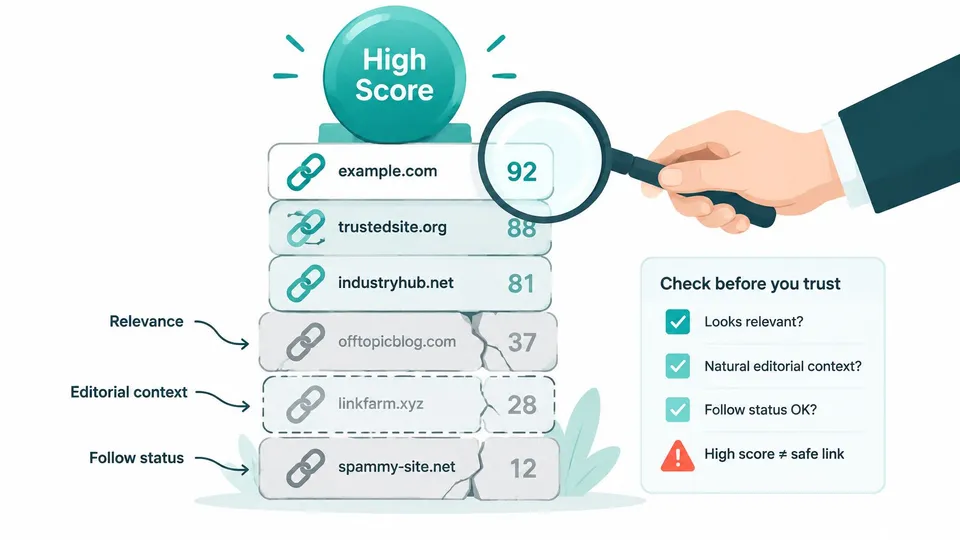
Review the links before you act
Start by sampling the highest-authority referring domains. Then classify each link:
- Relevance: Does the page discuss a topic your buyers care about, or is the mention a random software blurb?
- Editorial context: Is the link inside a real article, or dropped in a footer, sidebar, or scraped list?
- Follow status and placement: A followed link in the body isn't the same signal as a sitewide footer link.
- Anchor text: Over-optimized anchors on unrelated pages are a warning, not a trophy.
- Indexation: If the linking page isn't indexed, it isn't doing the job you think it is.
Next, calculate concentration. What share of referring domains, followed links, and apparent authority comes from the largest few domains? A profile that looks broad in the summary can be mostly one network.
Warning signs that survive a strong rating
Keep these on the list even when the displayed rating looks impressive. Ahrefs' guide to its backlink metrics treats them as common warning signs: high concentration, sitewide links, foreign-language pages with no tie to the product, and sudden bursts of low-quality referring domains.
Google classifies creating or exchanging links mainly to manipulate rankings as link spam. Paid or sponsored links are allowed when they're qualified with rel="nofollow" or rel="sponsored". A score from one vendor also shouldn't be converted into a success table against another vendor's score. Ahrefs' DR is link-based. Moz's Domain Authority model also folds in Spam Score, link-quality distributions, and traffic-related distributions. Those aren't equivalent percentiles.
After a link goes live, judge it by what happens next: qualified referral visits, indexed pages, relevant impressions, conversions, and sustained ranking movement. Manual review takes time. For a short list of prospects, checking a few links by hand is often more useful than collecting a long list of scores. If the admin work of outreach and placements is the bottleneck, compare that time cost with backlink service options instead of assuming every high score deserves a pitch.
What a Domain Rating Cannot Tell You About AI Visibility
When an AI summary appeared on a Google results page, users clicked a website 8% of the time, versus 15% for standard results, according to a 2025 study of 68,879 Google queries reported by Search Engine Journal. Only 1% engaged with the citations inside AI answers. That gap is why founders ask whether authority still matters. A domain rating checker never mentions citations, branded mentions, or sessions that start inside an AI product, yet those are exactly the outcomes founders now want.
The referral pattern runs the other direction. In the same reporting, an analysis of 19 GA4 properties showed AI-referred sessions rising from 17,076 to 107,100 between January and May 2025, a 527% increase (Search Engine Journal).
Wait, that would duplicate the URL. Same-source rule: each URL at most once in the article. Better: restate the source in the sentence without a second link? The flagged fix says "Add the Search Engine Journal link inside the GA4 sentence, or restate the source in that sentence." But dedup says every external URL at most once. So keep link on first sentence and restate source in second sentence.
Let me rewrite:
Decide Which Links Deserve Your Time
Use the score as one filter, then apply the checks you already know how to run: same tool, same day, followed links, relevance, concentration, and a plan to measure referrals. A domain rating checker shouldn't be the last step before you submit a product anywhere.
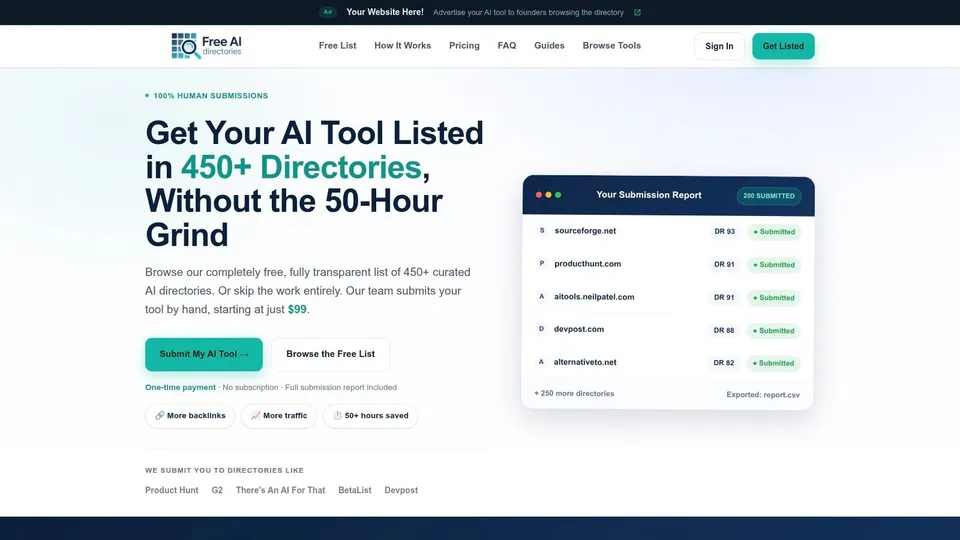
For AI directories, the Free AI Directories list is a starting point, not a finished media plan. The free list includes 450+ curated AI directories, each with its domain rating and free or paid status, and it's available with a free account and no credit card. The list shows each directory's DR, whether the listing is dofollow, and whether it's free or paid, and you can filter, sort, and search it. Details change, so confirm the live page, the relevance to your category, and the listing rules before you submit. A broader look at how directories fit a visibility plan sits in this guide to SEO web directories.
Two ways to do the work
Do it yourself when the shortlist is short. You control categories, descriptions, and logos, and you keep every login. The cost is time. Repetitive forms and new accounts can take hours that a small team would rather spend on the product. For a tight shortlist, that trade is often the better one, because you can see each form and stop when a directory looks off-topic.
Use a managed submission when the repetitive forms are the problem and you want a record of what was sent. A service can handle the forms and report the submissions. It can't guarantee approval, approval timing, a higher domain rating, rankings, or AI visibility. Free AI Directories doesn't guarantee specific Domain Rating increases, rankings, traffic, or revenue.
Keep one record per directory either way: live status, and the referral outcome you'll check after 90 days. Approval and indexing take time, so a submission log isn't the same thing as a live followed link. If the 90-day check shows no referral and no indexed listing, drop that directory from the next round instead of resubmitting on habit.
Free AI Directories keeps a searchable list of AI directories with domain rating, dofollow, and free or paid status, so you can screen prospects before you spend time on a submission. Pair that list with the checks in this guide, and treat every score as a filter rather than a grade. Visit Free AI Directories to open the list with a free account and decide which directories deserve a place on your shortlist.
Ready to list your AI tool?
Get your tool in front of users across hundreds of AI directories.
Submit Your Tool →