
Directory Listing SEO: What Actually Helps Rankings
Directory listing SEO explained: when listings support rankings, how to pick directories that send real visitors, and how to measure results.
By Free AI Directories Team · November 26, 2026
The standard advice on directory listing SEO runs in one direction: submit your product everywhere, collect backlinks in bulk, and wait for rankings to climb. AI and SaaS founders who follow that advice often burn days filling out profiles on directories nobody visits, and end up with little to show for it.
The problem is a wrong model of what a listing does. A directory profile is not primarily a backlink. It is a copy of your product's identity, name, category, description, and positioning, published on a site that search engines can crawl and buyers can browse. Value comes from the consistency and placement of that data, not from how many times you replicate it.
That reframing changes the work. Entity-data distribution means choosing directories your buyers use, then publishing one identical product record across all of them. Referral acquisition means treating each listing as a small traffic channel and measuring what it sends. Structured markup, approval rates, and quarterly performance reviews matter more than raw counts.
The sections below work through each piece: how many listings justify the effort, how to screen directories, what a reusable listing record looks like, and how to tell whether a listing helps, hurts, or does nothing.
Table of Contents
- Where Directory Listings Fit in Your SEO Plan
- How Many Listings You Actually Need
- Directory Types and How to Screen Them
- Writing One Listing Record Every Directory Can Use
- Structured Data for Your Product Page
- Measuring Whether a Listing Helps, Hurts or Does Nothing
- Doing It Yourself or Paying Someone
- Build Your Directory Shortlist and Start Today
Where Directory Listings Fit in Your SEO Plan
A directory listing is a support signal that helps search engines interpret your product, not a shortcut to first-page rankings.
According to Google Business Profile local ranking documentation, local search results depend primarily on three factors: relevance, distance, and prominence. Directory listings feed relevance and prominence when they carry accurate, consistent details on credible, contextually appropriate websites. Distance depends on where the searcher sits or which location they type, while prominence draws on wider web recognition including articles, links, and brand mentions, which means no directory submission can promise a fixed ranking position.
Historical industry weighting puts directory signals in clear perspective. In Moz's 2018 Local Search Ranking Factors survey, respondents estimated citation signals as a modest slice of the overall mix, and Moz noted that citation influence had been declining as accurate listings became standard across the web.
| Local ranking factor group | Estimated share in Moz 2018 survey | Role relative to directory profiles |
|---|---|---|
| Google Business Profile signals | About 25% | Primary profile completeness and category alignment |
| Link signals | About 16% | Inbound link authority and anchor relevance |
| Review signals | About 15% | Review volume, velocity, and ratings |
| On-page signals | About 14% | Website content, crawlability, and keyword match |
| Citation signals | About 11% | Structured business details across directories |
Those figures measure local search rather than global software queries, so treat them as directional context rather than exact targets. Even in local search, where citations carry their clearest traditional role, listings sit behind core website quality, links, and customer reviews.
What a Directory Listing Can and Cannot Influence
When a software founder publishes clean, consistent listings across vetted sites, four realistic outcomes follow:
- Entity validation: Search engines cross-check your product name, canonical URL, publisher identity, and category across independent pages to confirm what your software is.
- Category relevance: Appearing inside an accurately matched software category reinforces topical associations for your core use case.
- Referral discovery: Buyers actively filtering tools by pricing model or feature set can click straight through to your landing page.
- Crawlable link signals: A crawlable profile on an editorial directory can contribute a legitimate reference link alongside your broader website content.
Consistent, crawlable listings across several sites are a reasonable bet, not a promise. A listing can't compensate for a slow landing page, weak positioning, or a product nobody searches for. Duplicate or conflicting profiles can also erode data consistency and confuse both crawlers and prospective users.
Working rule: A small set of accurate, relevant profiles usually beats hundreds of weak placements, and every extra directory needs a clear reason beyond links.
How Many Listings You Actually Need
Founders frequently ask for a target number before they start submitting. Published studies give useful benchmarks, provided you read them with a strict caveat: nearly all large-scale citation datasets measure local brick-and-mortar businesses, not cloud software or AI tools.
In BrightLocal's SEO citations study of 122,125 local businesses across 26 industries, companies ranking in the top 10 Google Local positions averaged 81 citations, with 86 citations for position one and 85 citations for positions one through three. Because those figures track local mentions of business name, address, and phone number, 81 isn't a quota for a SaaS product.
Distribution studies point toward a clearer underlying mechanic. A listings management study hosted by Moz analyzed 115,000 business locations across the United States, United Kingdom, Germany, and France, finding that locations listed on more than 10 sites showed an average 80% improvement in local visibility on Google and a 67% increase in consumer actions. Distribution past 30 directories aligned with more than a 136% increase in user actions, while profile completeness alone corresponded to a 69% increase in website clicks.
Buyer behavior and practitioner surveys reinforce why directories still matter for discovery. In BrightLocal's 2024 business listings visibility study of 8,000 search-engine results, business directories accounted for 31% of local-intent organic results. Separately, 43% of marketers named citation building and cleanup among the most valuable local SEO services in BrightLocal's 2024 Local Marketing Industry Survey.
| Source and sample | What was measured | The number | How to read it |
|---|---|---|---|
| BrightLocal citation study, 122,125 local businesses, 26 industries | Average citations for top 10 Google Local results | 81 citations, 86 for position one | Local businesses only, not a target for software |
| Listings management distribution analysis (via Moz), 115,000 locations, US, UK, Germany, France | Local visibility for businesses on more than 10 sites | Average 80% improvement | Relevant coverage, not volume on any site |
| Same distribution study | Consumer actions for businesses on more than 30 directories | More than 136% increase | Diminishing returns apply, local dataset |
| Same distribution study | Website clicks linked to profile completeness | Average 69% increase | Completeness matters more than count |
| BrightLocal analysis of 8,000 search results, 2024 | Directories' share of local-intent organic results | 31% | Shows where buyers browse |
| BrightLocal Local Marketing Industry Survey, 2024 | Marketers rating citation building and cleanup valuable | 43% | Practitioner view, not ranking proof |
Turning Local Numbers Into a Software Coverage Rule
The lesson for AI and SaaS products isn't to chase 80 or 300 listings. Returns come from relevant coverage and complete profiles, while low-quality extra listings produce diminishing returns fast.
Start by mapping the specific directories your target buyers already check when comparing tools in your category. Fill out every available field completely, including accurate pricing models and current screenshots. Expand your list only when existing placements start showing measurable referral visits or branded search activity.
Directory Types and How to Screen Them
Not every site that lists software serves the same purpose. Before submitting a single form, group potential targets into five distinct directory categories and run a strict quality check on each one.
| Directory type | Main value | Check before submitting | Warning sign |
|---|---|---|---|
| Discovery directories | Users browsing tools by category | Audience matches your buyers | Little visible traffic or recent updates |
| Review and comparison sites | Buyer research and opinions | Published editorial rules | Pay-to-rank language with no criteria |
| Startup databases | Early awareness among founders | Profile is crawlable and maintained | Listings left untouched for long periods |
| Local or business directories | Location-based discovery | Your product serves a location | Forced location fields for a global product |
| Niche software indexes | Visibility with category buyers | Category fits your primary function | Categories stuffed with keywords |
Separating sites by type prevents wasted effort. A developer tool built for remote engineering teams doesn't belong in regional small-business yellow pages, while an AI scheduling app built for dental clinics might benefit from healthcare software indexes alongside general AI discovery hubs.
Six Screens That Filter Out Weak Directories
Once a directory fits one of the types above, evaluate the individual domain before creating an account. Most thin directories fail at least two of these six checks:
- Audience match: Browse five existing listings on the site and ask whether your actual buyer would spend two minutes comparing products there.
- Active maintenance: Check timestamps, recent additions, and working outbound links to confirm editors still curate the site.
- Editorial standards: Look for submission guidelines, moderation notices, or clear category rules rather than instant automated publishing for every URL.
- Category alignment: Verify that a specific category matches your software's primary job, not a vague catch-all tag.
- Search engine crawlability: Inspect a live listing page to confirm search engines can index it without login walls or noindex tags.
- Update controls: Confirm you can edit pricing, descriptions, and URLs later if your product changes direction.
Domain metrics alone can't replace those six checks. If you want to understand how authority scores work alongside editorial quality, review this guide on using a domain rating checker before weighing any third-party score in your shortlist.
Where Directory Submissions Cross Into Link Spam
Submitting indiscriminately doesn't just waste time; it can introduce risk. Under Google Search spam policies, links from low-quality directory or bookmark sites count as link spam when used to manipulate search rankings. The same policy identifies buying or selling links for ranking purposes and excessive link exchanges as spam.
A directory backlink isn't automatically an SEO asset. Sites that accept every submission without moderation, show no update dates, and display thin lists of unrelated links exist solely for link placement rather than user discovery.
Submit only where a real buyer could discover your tool, and skip any directory whose only visible purpose is selling or hosting links.
Writing One Listing Record Every Directory Can Use
A directory listing works best as a reusable entity record. Treat each submission as a controlled copy of the same product facts, then adapt only the presentation to the directory. That keeps names, URLs, pricing claims, and descriptions aligned across sites that may be read by buyers, moderators, and search engines.
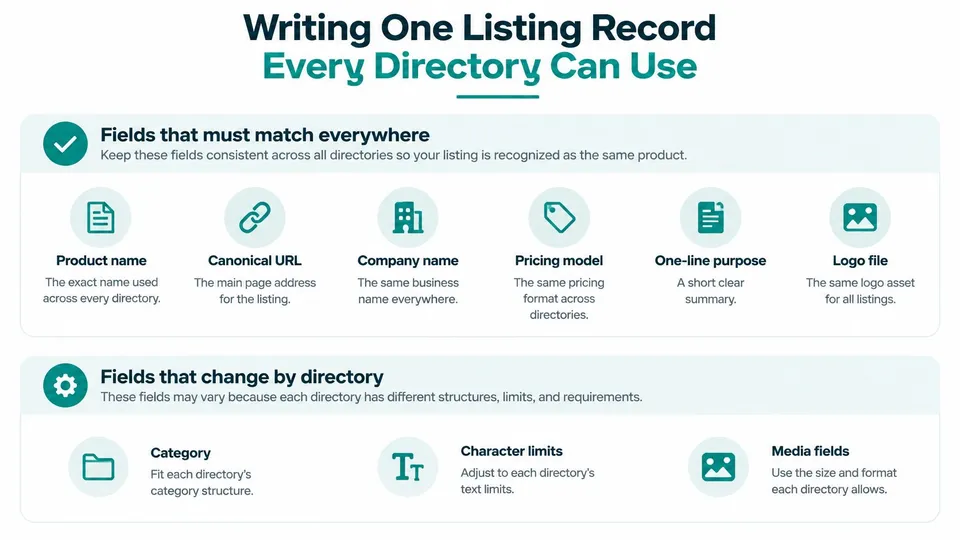
Build one master listing record before opening forms. Core identity fields should stay identical everywhere: exact product name, canonical URL, company name, pricing model, and logo file. Character-limited summaries, long descriptions, category tags, image dimensions, and field order can change, but the underlying facts should not. The practical test is simple: if two listings describe the same product differently, one of them is outdated or careless.
| Field | Fixed or adaptable | What to check |
|---|---|---|
| Product name | Fixed | Matches the name on your site and logo file |
| Canonical URL | Fixed | Opens the product page, not a redirect or signup wall |
| Company name | Fixed | Same brand or legal name on every profile |
| Pricing model | Adapts in wording, facts fixed | Matches the current pricing page |
| One-line purpose | Adapts to character limits | Says what the tool does without repeating search terms |
| Long description | Adapts to text limits | Carries the same facts as the short version |
| Primary category | Adapts to directory taxonomy | Describes the main function, one category only |
| Screenshots | Adapts to size limits | Current interface, no outdated pricing |
| Logo file | Fixed | Correct dimensions for each directory |
| Submission log | Fixed | Directory name, date, status, last verification |
Six Steps to Prepare and Adapt Each Submission
Follow this sequence before opening any directory submission form so every entry stays accurate and clean:
- Choose one primary category: Pick the single category that describes what your software does first. As Google's guidelines for representing a business specify, profiles should represent the core offering accurately using the fewest categories needed, rather than adding categories as keywords or attributes.
- Draft a plain one-sentence purpose: Explain who the tool serves and what problem it solves in everyday English. Keyword piles make the copy harder to read and can create avoidable moderator problems.
- Write a longer factual description: Expand on key workflows, integrations, and supported formats using the exact same pricing and feature facts from your landing page. Rewriting the phrasing slightly per directory avoids mechanically identical copies across the web.
- Verify your destination URL: Paste your canonical product URL into an incognito window and make sure it loads directly without a redirect chain or a forced login wall.
- Match pricing details to your live site: If you advertise a free tier or trial on directories, confirm that exact offer sits visibly on your pricing page right now.
- Log every submitted version: Record the directory name, submitted copy, submission date, approval status, and account credentials in your master sheet immediately after hitting submit.
The difference between a clean description and a weak one is usually specificity. "AI SEO tool for teams, keywords, content, backlinks, traffic, rankings, growth" gives a moderator little to verify and gives a reader little to understand. "A keyword research tool that helps SaaS teams group search terms and draft product pages" states the audience and job plainly, while keeping the claim narrow enough to match the product page. Use the same discipline when formatting copy and avoiding common rejection triggers in this walkthrough on how to write a listing before submitting your batch.
Structured Data for Your Product Page
Directory profiles don't work in isolation. They point back to your website, and search engines interpret your product more accurately when both the directory entry and your own landing page expose matching, machine-readable identity facts.
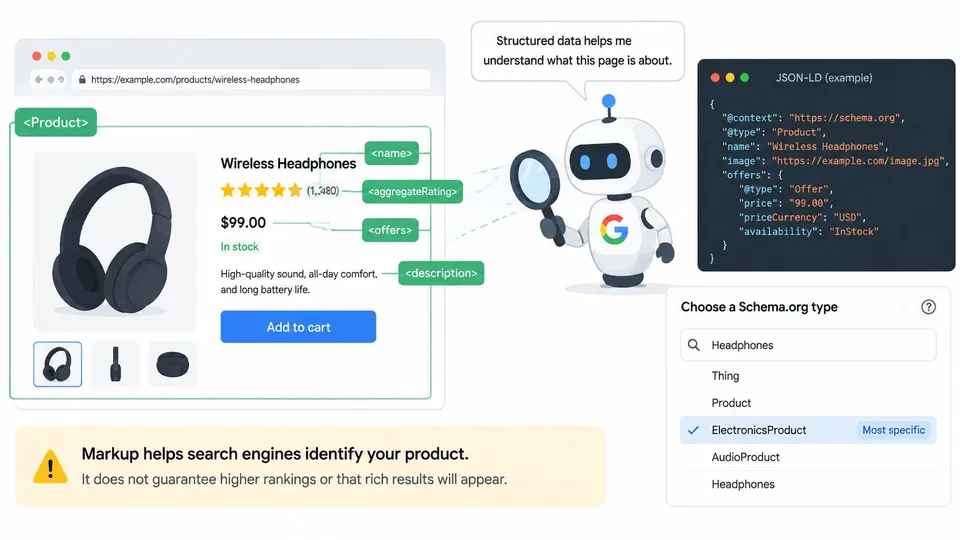
Per Google's general structured data guidelines, Google recommends JSON-LD markup, requires structured data to accurately represent visible page content, and states that pages must stay accessible to Googlebot. Structured data doesn't guarantee higher rankings or rich-result display, and marking up hidden content or violating spam policies can make a page ineligible for enhanced presentation.
Choose the most specific Schema.org type that fits your offering. For most SaaS and AI tools, SoftwareApplication fits far better than a generic webpage tag. Include stable identity properties that mirror your master directory record: name, url, logo, description, and publisher. Connect external directory profiles to that canonical product page with standard crawlable links rather than tracking redirects.
If your business also operates a physical office or serves a specific geographic territory, check Google's LocalBusiness documentation for required address and operating-hours properties before publishing. Using an unsupported schema type, blocking crawlers, or publishing contradictory identity fields between your website and directory profiles creates quality-control issues rather than search clarity.
Five Validation Checks Before You Publish
Treat markup deployment as an operational check rather than a set-and-forget snippet. If you want a deeper technical reference while setting up fields, NanoPIM's guide to testing product schema markup covers how structured data properties map to search interpretation.
Run these five checks after deploying JSON-LD on your product page:
- Test syntax in Google's Rich Results Test: Confirm the JSON-LD parses without syntax errors or missing required fields for your chosen Schema.org type.
- Inspect the rendered HTML: Verify that client-side JavaScript isn't failing to inject the markup when Googlebot renders the page.
- Confirm indexability: Check
robots.txtand meta robots tags so crawlers can fetch the page freely. - Check canonicalization: Confirm the canonical tag on your landing page matches the exact URL listed in your master directory record.
- Monitor Search Console enhancements: Watch the enhancements reports over the following weeks to catch warnings or invalid items after site updates.
Measuring Whether a Listing Helps, Hurts or Does Nothing
Directory profiles decay over time. A product ships with new pricing, a redesigned interface, and a renamed feature set, while listings created at launch still advertise an obsolete free plan. Each stale page is a public record contradicting your current positioning, and buyers comparing options notice the mismatch before they ever reach your site.
In BrightLocal's 2025 Local Consumer Review Survey, based on a representative panel of 1,026 US adults, consumer evaluation closely tracked recency, review count, and star rating. The sample reflects local-business behavior, so the transfer to software directories is imperfect. The mechanism still applies: buyers read a directory profile as evidence about the product today, and an abandoned or inaccurate page reads as neglect. A live listing functions as a maintained public record, and every edit either strengthens or weakens that record.
Measuring real outcomes also prevents overinvesting in a channel with shifting returns. Whitespark's 2020 Local Search Ranking Factors summary reported that experts viewed citations as declining in importance as ranking signals over successive surveys. That finding comes from local search, and AI and SaaS directories sit in a different environment where results vary sharply by query type and vertical. Because no single ranking factor study covers this channel directly, the honest measurement unit is the individual listing: the referral traffic it sends, the signups it produces, and whether assistants name your product after it goes live. A rising domain rating score on a directory never proves any of that.
| Metric | What it tells you | Where to check | Review cadence |
|---|---|---|---|
| Referral sessions | Visits arriving from each directory | Analytics referral reports | Monthly |
| Indexed listing pages | Whether search engines find the profile | Index or site search checks | Quarterly |
| Branded search volume | Awareness after listings go live | Search Console | Monthly |
| Qualified signups | Visitors who match your target user | Product analytics | Monthly |
| AI assistant mentions | Whether assistants name your product | Manual sampled prompts | Quarterly |
| Fact accuracy | Whether name, URL, pricing and category match | Manual page review | Quarterly |
The Quarterly Maintenance Routine
Directory listings reward continuous upkeep the same way any small portfolio does. Set a calendar reminder once per quarter and run through five focused actions:
- Audit your tracking sheet: Confirm every live listing has its canonical URL, assigned category, approval status, and last verification date recorded.
- Compare referrals and signups: Rank directories by qualified signups and engaged referral visits, not raw impressions. A directory sending fifty visits that convert beats one sending five hundred that bounce, and this ranking tells you where to concentrate effort. Pair that analysis with broader link acquisition strategies covered in this guide on how to get backlinks.
- Fix stale or conflicting facts: Open your top-performing profiles and check pricing models, screenshots, feature descriptions, and destination URLs against your current website.
- Clean up duplicates and misleading entries: Request removal or merges if an old beta name or scraped duplicate appears on the same platform.
- Sample AI assistant responses: Run a small, consistent set of category prompts each quarter to log whether assistants cite your site or specific directories, without overreacting to one-off changes. Single responses fluctuate; the trend across quarters is the signal.
A healthy directory portfolio doesn't require hundreds of live pages. It shows steady referral visits from directories matching your buyers, accurate facts on every active profile, and zero conflicting information across the web. Anything less than that is a measurement problem you now have the routine to catch.
Doing It Yourself or Paying Someone
Once a shortlist exists, founders face a practical routing decision: fill out the forms in house or pay someone to handle submissions. Both routes can produce clean listings, and each involves clear trade-offs in time and control.
Submitting manually keeps every decision in your hands. You verify each directory directly, choose the exact wording and category, test screenshots yourself, and hold every login from day one. The cost isn't cash; it's founder hours spent creating accounts, confirming verification emails, resizing images, and updating your tracking sheet.
A paid submission service shifts that administrative work off your plate. Someone else creates accounts, formats descriptions to fit character limits, submits the forms, and compiles a status report. That route makes practical sense when your vetted shortlist is long and repetitive form work is delaying product development or customer outreach.
When Manual Submissions Beat Paid Help
Paid help comes with hard limits that no vendor can remove. Some directories approve listings within hours, while others take weeks, and a directory may decline a listing at its discretion. Paying a service also won't keep your profiles accurate six months later when your pricing tiers, product positioning, or landing page URLs change.
Paying for form work buys back founder hours, not editorial approvals or ongoing data accuracy.
Apply a quick test before spending money. Count the exact number of directories you want your product on after applying the six screening checks. If that shortlist is small and tightly targeted, submit by hand this week and keep the tracking sheet in house. If the vetted shortlist is long and your calendar is the main bottleneck, outsourcing the manual form work is reasonable as long as you retain the logins and own the quarterly review.
For most early-stage AI tool founders, a short, hand-picked list submitted manually from one master record beats a massive batch of unverified submissions every time.
Build Your Directory Shortlist and Start Today
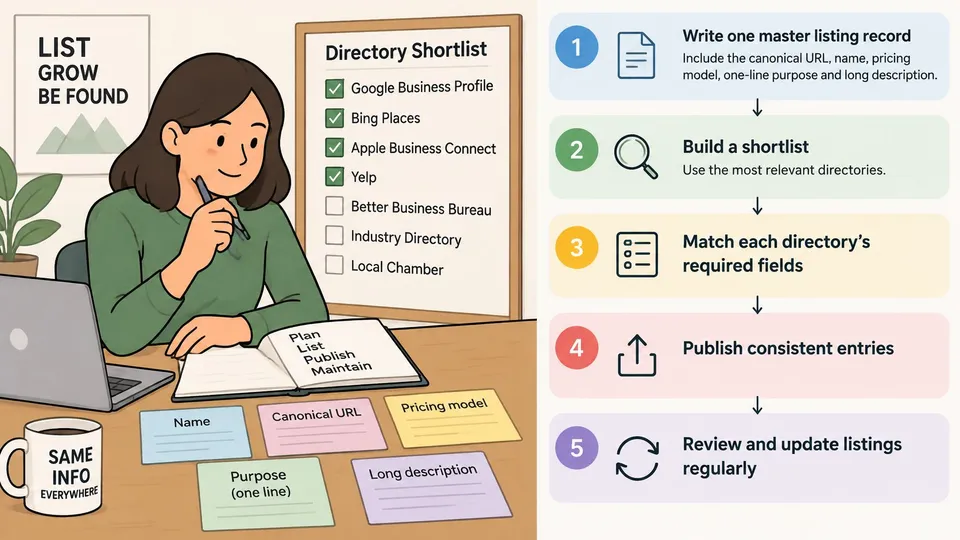
A working directory portfolio comes from a fixed sequence: one master record, a screened shortlist, documented submissions, measured outcomes, and scheduled maintenance. The order matters because each step depends on the one before it. A shortlist built before your canonical record is locked produces inconsistent entity data across the web, and submissions made without tracking leave you unable to judge whether any of it worked.
The mechanics of each step are covered earlier in this guide: the master record fields, the six screening checks, the analytics setup, and the quarterly review routine. What belongs here is the discipline of sequencing. Write the record first, screen before you submit, log every submission the day it happens, and let one full quarter of referral data decide where you expand. Founders who skip the sequencing end up with scattered, inconsistent listings and no way to tell which directories send real users.
Where to Source and Manage Your Shortlist
Finding active, vetted AI and SaaS directories from scratch takes hours because static spreadsheets go stale quickly. Domains expire, submission queues close, and pricing terms change without notice. Free AI Directories maintains a free directory list of 450+ curated AI directories, showing each directory's domain rating and free or paid status, available with a free account and no credit card. Whatever source you use, confirm current listing terms directly on the directory itself before submitting, rather than relying on an outdated screenshot or an old forum post.
Start small this week. Pick the handful of credible directories your buyers already browse, publish complete profiles from your master record, track referral visits and branded searches for one full quarter, and expand only where the data proves real demand. A short, consistent, measured portfolio of listings does more for entity data distribution than a long list assembled in a single weekend and never revisited.
Free AI Directories gives AI and SaaS founders a curated database of over 450 directories with domain ratings and pricing status so you can build a screened shortlist without guessing. Whether you submit manually or use the hand-submitted reporting service while keeping full login control, you can explore the directory list and start planning your submissions at Free AI Directories.
Ready to list your AI tool?
Get your tool in front of users across hundreds of AI directories.
Submit Your Tool →