
9 AI Marketing Tools for SaaS Founders in 2026
Nine AI marketing tools for SaaS founders, grouped by task: directories, SEO research, outreach, and social scheduling. Honest limits included.
By Free AI Directories Team · November 24, 2026
The product works. The homepage is live. The founder has a folder of screenshots, a half-finished launch post, and a spreadsheet of directories that may or may not accept submissions anymore. Marketing keeps slipping behind the next bug fix.
Most founders don't need nine tools. They need a way to get found, a way to research demand, and a way to reach people who might care. AI marketing tools help when they remove a specific bottleneck, not when they create another dashboard to check.
That distinction matters for a small SaaS team. A directory listing needs accurate product details. A launch needs follow-up. A keyword report needs someone to publish a useful page. Even sales intelligence platforms need a clear audience and a relevant offer before contact data becomes useful.
A spreadsheet and an afternoon of focused work can beat a subscription that nobody has time to learn.
The useful order is practical: get listed, launch, research demand, find contacts, then maintain a posting habit. The tools below support that sequence. Not every entry is an AI-native application. Some handle the ordinary distribution work that an AI product still needs, and each has a point where doing the job manually makes more sense.
Table of Contents
- 1. Free AI Directories
- 2. Product Hunt
- 3. Ahrefs
- 4. Semrush
- 5. BuzzSumo
- 6. Hunter
- 7. Apollo.io
- 8. Buffer
- 9. Taplio
- How The Nine Tools Compare On Job, Cost Model, And Main Trade-Off
- Run Three Tools for Eight Weeks, Then Check the Numbers
1. Free AI Directories
The job is finding relevant directories and completing submissions without losing track of them. Free AI Directories combines a searchable directory database with paid, manual submission services for AI products. The database includes more than 450 curated directories, with domain ratings, dofollow information, and free-versus-paid listing status.
A solo developer can use the database to build a shortlist, then submit independently. A niche B2B founder can filter for relevant destinations instead of treating every available listing as equally useful.

Prepare the assets before opening forms
Keep a logo, readable interface screenshots, short and long descriptions, and a consistent destination URL together. Choose a specific category that describes the product's actual job, not every market it might eventually serve.
Google's business-profile guidance recommends specific, representative categories. Although AI directories have their own rules, that principle is useful: accurate categorization is better than selecting every vaguely related option.
- Adapt the description. Match each directory's fields and explain the task the product performs.
- Check current status. Confirm submission requirements before spending time on an entry.
- Keep the records. Save the submitted wording, account details, and publication status.
Manual submission is the better call when the shortlist is small and positioning still needs work. Paying makes more sense when repetitive forms are taking time away from development. The managed service supplies submission evidence and login details, but guarantees submissions rather than approval or ranking improvements.
2. Product Hunt
A recruitment-software founder launching an AI meeting-summary tool needs the page to prove one thing fast: it understands agency interviews. Show intake notes, candidate handoff, and where the summary lands. A generic demo wastes the click.
Product Hunt handles a concentrated launch event. Makers publish products, and visitors discover, discuss, and vote on them. It can support early feedback and referral traffic. Platform attention can bring visitors, but activation happens only when those visitors complete the core task.
Build the path beyond the launch page
The demo should stay inside the recruitment workflow. The landing page should continue that same story, with an obvious route to trying the relevant feature. If the first session ends before a summary is created, the launch did its job only halfway.
Preparation should cover the practical details:
- A clear tagline. Describe the outcome without stacking AI terminology.
- A short demonstration. Show the product completing its main task.
- A working next step. Send visitors to a usable signup flow or clearly explained waitlist.
- Comment coverage. Arrange time to answer questions and record objections.
Read the platform's current launch and promotion guidelines before sharing the launch page. Existing users and followers can receive a straightforward announcement, without prohibited requests for votes.
Doing the work by hand is usually appropriate for a founder's launch. Direct replies reveal confusion that templated promotion misses. If visitors repeatedly misunderstand the product, revise the positioning and onboarding rather than buying more launch software. A launch is useful when the team can learn from it and follow up afterward.
3. Ahrefs
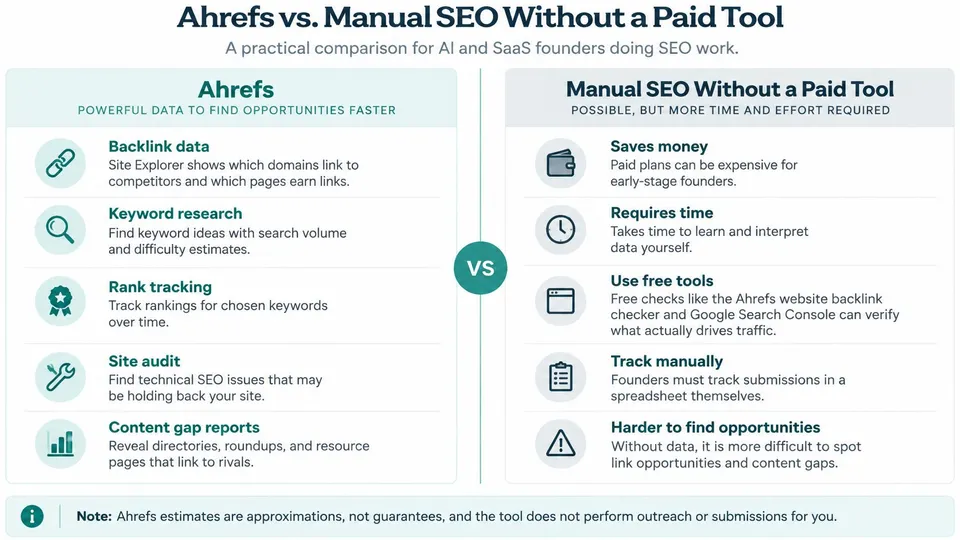
Ahrefs is useful when the question is where competitors earn links and which search opportunities deserve attention. Its backlink analysis, keyword research, rank tracking, and site-audit tools support investigation. They don't guarantee that another site will link to a product.
Consider a founder comparing competing AI transcription products. Their referring domains may include software directories, comparison articles, integration pages, and unrelated mentions. The useful work is separating genuine opportunities from pages that merely happen to contain a link.
Look for patterns, not impressive scores
A founder comparing sites should understand what domain rating means before using it to sort outreach targets. A metric can help organize research, but topical relevance and a useful listing matter more than collecting high-scoring domains indiscriminately.
Google's spam policies define link spam as creating links primarily to manipulate rankings. Directory research should therefore prioritize discovery and useful referrals, not manufactured link volume.
- Inspect the page. Check whether people can find and understand listed products.
- Record the fit. Explain why the product belongs before submitting or contacting an editor.
- Match against existing work. Compare opportunities with the submission spreadsheet to avoid duplicates.
Manual research wins when the competitor set and publishing plan are still small. Start with Ahrefs' free backlink checker before considering a paid plan. A subscription becomes easier to justify when research regularly produces specific pages to build, fix, or pitch.
4. Semrush
Search research works best when the next decision is clear. A small SaaS team should pay for Semrush when keyword, competitor, content, backlink, social, or advertising research has become a repeated job. Semrush suits a founder who wants search research and content planning in a broader marketing platform, rather than a separate tool for every task.
Its feature set covers keyword research, competitor analysis, backlink audits, content planning, and social and advertising management. Breadth helps only when someone owns the work and uses the output. Otherwise, the team pays for options while publishing and outreach stay untouched.
Buying rule: Choose the report that supports the next decision.
An AI proposal-writing product may need its next guide topic. A keyword gap report can show terms competing products target. The useful step comes next. Inspect the actual results, separate buying intent from general curiosity, and decide whether the product can answer the query well.
Start with a single research question
A focused workflow keeps the platform manageable:
- Name the question. Identify a content gap, backlink gap, or technical issue before opening reports.
- Filter for relevance. Remove topics and referring domains that don't match the intended buyer.
- Assign an action. Give each selected opportunity a page, owner, or outreach task.
Compare third-party estimates with Google Search Console to understand what already drives impressions and clicks for the site. That check keeps planning grounded in existing demand instead of replacing it with platform scores. Check current subscription limits before committing, especially when exports or repeated competitor checks are central to the workflow.
Manual work is better when the founder hasn't settled the audience or offer. Search results, customer questions, and a planning document can support the initial content decisions. Semrush becomes useful when recurring research, rather than unclear positioning, is the bottleneck. In that stage, the practical gain is speed: fewer scattered tabs, less repeated sorting, and a clearer queue of pages, fixes, and outreach targets.
5. BuzzSumo
An active conversation leaves traces. A shared article, a repeated question, or a cluster of mentions can show where a topic is getting attention. BuzzSumo helps with content research and identifying relevant writers, so a founder can study what gets discussed and who is discussing it. Share counts show attention only. They sit one step before demand, positioning, and sales.
For an AI writing product, content discovery can expose comparison articles that keep appearing. The useful move is to read them closely and note what they explain well, what they skip, and which questions readers keep asking around them. That gives the team a sharper content angle than another feature list.
Find the missing explanation
Existing articles may compare writing quality while barely discussing review workflows. A founder whose product supports editorial approvals could publish a practical guide to checking generated drafts, preserving source material, and assigning final approval.
That is a stronger contribution than rewriting the same feature roundup. The wider guide to AI tools for business can help frame adjacent workflows, while the finished article should remain specific to its intended reader.
- Read before pitching. Check an author's recent work and the audience it serves.
- Track relevant mentions. Monitor product and competitor names for conversations worth reviewing.
- Question the signal. Use share counts to spot attention, then check the article, comments, and source context before acting.
A manual approach is better for a narrow niche with a manageable set of publications. Reading newsletters, searching recent articles, and recording authors in a spreadsheet may provide enough context. BuzzSumo becomes more useful when monitoring and discovery recur across many topics.
Avoid turning the author list into a mass outreach list. A relevant observation, useful example, or different product capability gives a writer something to consider. A generic request for coverage doesn't.
6. Hunter
Outreach often stalls after the publication list is done. The next job is finding the person who reviews tools, maintains the resource page, or handles partnerships. That work is tedious but narrow. It rewards careful checks, then gets faster with a tool that finds and verifies professional addresses.
Hunter handles professional email discovery and verification. Its domain search, email finder, and verifier can reduce contact research when a relevant person is known but their address isn't easy to locate.
Find the person before finding the address
A founder finds a newsletter covering AI tools for accountants. Before searching for an email address, they should read recent issues, identify the editor, and confirm that product recommendations fit the publication. That check takes time. It also prevents a good list from turning into a bad send.
A short message can then explain the audience fit, name the product's specific use case, and offer access or supporting details. The pitch shouldn't pretend that a standard feature is exclusive news.
- Use public routes first. A submission form or published editorial address may be the preferred channel.
- Verify carefully. An address check doesn't establish consent or guarantee delivery.
- Respect recipients. Include a clear opt-out route and honor requests not to receive further messages.
Commercial email requirements vary by jurisdiction. The sender needs to check the rules that apply and avoid assuming that a discovered professional address can be used without restriction.
Manual contact research is better for a short, high-value list. A publication's contact page may answer both where to send the message and what the editor wants. Hunter earns its place when finding and checking relevant addresses becomes repetitive. Hunter speeds up contact research for a relevant offer. It cannot make an irrelevant pitch relevant.
7. Apollo.io
Apollo.io belongs in a partner or buyer prospecting workflow, not an SEO reporting workflow. It combines B2B contact discovery, email sequencing, and CRM-style tools. That makes it relevant when a founder can define the businesses and roles worth contacting.
For example, a SaaS founder selling an AI reporting tool might seek agencies that manage client reporting. The offer could be a partner demonstration or a discussion about a specific workflow. A request for a backlink would be a poor substitute for a useful commercial reason to talk.
Contact data makes a relevant conversation easier to start. It doesn't make an irrelevant message worth sending.
Define the segment before building the sequence
A useful prospecting record needs more than a name and address. Record the company's fit, the recipient's role, the reason for contact, and the proposed next step.
- Keep the segment narrow. Agencies, integration partners, and direct buyers need different messages.
- Make the reason explicit. Name the relevant service, workflow, or complementary product.
- Track replies and exclusions. Remove contacts who opt out and stop sequences when a conversation begins.
Database filters are a starting point, not proof that a company needs the product. Claims about another business's software stack or priorities should be checked before appearing in a message.
Manual prospecting is better before the offer has earned useful replies. A founder can learn more from carefully researching prospective partners than from importing a large contact list. Apollo.io becomes useful when the segment, message, and follow-up process are already clear enough to repeat responsibly.
8. Buffer
A release date is already on the calendar, and the queue still needs posts that teach something useful. Buffer handles scheduling, publishing, and engagement review across social accounts, helping a small team maintain a posting habit.
Fill the queue with tutorials, limitations, support answers and changelog updates. Each post should make sense on its own, because readers rarely arrive in the order a launch team imagined.

Schedule useful material, not filler
The release queue can hold educational posts, the announcement and a short follow-up on what changed. Buffer keeps those posts moving while the founder answers questions and handles replies. Scheduled content should still reflect a decision from the wider SaaS marketing strategy, including which audience and channel deserve attention. The scheduler executes that decision. It does not make the decision better.
- Teach a concrete task. Show a workflow, input, output, or limitation.
- Choose a clear next step. Ask readers to try the feature, read the guide, or answer a question.
- Leave time for replies. Scheduled publishing doesn't replace conversation.
Check each platform's current link and automation rules before the queue goes live. Review queued posts when product details change. An old screenshot or outdated feature claim can make scheduled content misleading.
I would use native scheduling for one channel and a small set of posts. Buffer earns its place when switching accounts, coordinating posts, or reviewing publishing activity starts to take real time. If there isn't enough useful material to publish, adding a scheduler won't solve that problem.
9. Taplio
LinkedIn content works best when a founder has something specific to explain. Taplio supports LinkedIn-focused idea development, drafting, scheduling, and engagement tracking. Its value is a repeatable writing process, not an outsourced point of view.
A B2B SaaS founder might describe why a feature now requires human approval before sending an automated response. That post can explain the trade-off, show the workflow, and ask readers how they handle the same problem.
Keep the evidence in the founder's hands
Templates can help shape a rough draft, but the founder must check every product detail and remove claims that the business can't support. Customer stories need permission and accurate outcomes. When those aren't available, a clearly framed product demonstration is better than an invented success story.
Governance matters even in a small content workflow. Research from the Australian Centre for AI in Marketing and Kantar found that 83% of surveyed organizations were still in the early stages of embedding AI into marketing operations.
- Edit for a real viewpoint. Replace broad claims with an actual decision or trade-off.
- Protect sensitive information. Keep private customer details and confidential campaign material out of drafting tools.
- Handle conversations directly. Reply personally and avoid automated mass messaging.
Manual posting is better while the founder is still discovering what deserves a regular series. LinkedIn's native publishing tools and a draft document can support that stage. Taplio becomes easier to justify when LinkedIn is already a useful channel and planning or drafting, rather than a lack of substance, limits consistency.
How The Nine Tools Compare On Job, Cost Model, And Main Trade-Off
| Item | Job | Cost Model |
|---|---|---|
| Free AI Directories | Find AI directories, get listed in its own AI tools directory, and submit tools by hand to directories in the chosen plan | Free listing option; free research access; one-time submission packages from $99. The $99 plan covers 80 directories, $149 covers 200, and $199 covers 300 |
| Product Hunt | Launch a product and gather early users and feedback | No cost details provided |
| Ahrefs | SEO research, backlink analysis, and tracking | Paid plans; free backlink checker available |
| Semrush | SEO, competitor research, and content planning | Paid plans; exact pricing not provided |
| BuzzSumo | Content research and finding relevant writers | Paid plans for many features |
| Hunter | Finding and verifying professional email contacts | Paid plans or credits may be needed |
| Apollo.io | Building targeted B2B prospect lists and outreach | Paid plans for full features |
| Buffer | Scheduling posts across social accounts | Free plan may be available; paid plans add features |
| Taplio | Planning and scheduling LinkedIn content | Paid plans for most features |
The useful split is simple. Use Free AI Directories when the job is listing and submission work. Use research tools when the job is finding demand and keywords. Use contact tools when the job is reaching specific people. Use scheduling tools after there is something worth posting.
Free AI Directories fits the first step in a small SaaS workflow. It runs its own AI tools directory, offers free and paid placements, and sells done-for-you human submissions. Paid plans are one-time payments, with no subscription. The Pro plan includes a one-week feature on the AI Tools page, a verified badge, and a do-follow backlink.
Product Hunt fits the launch moment. It is for getting a product in front of early users and collecting feedback. The cost model is not specified here, so treat it as a separate launch decision rather than an always-on marketing line item.
Ahrefs and Semrush do different research jobs. Ahrefs is better framed around SEO research, backlinks, and tracking. Semrush covers SEO, competitor research, and content planning. Both can consume paid-plan budget, and both require someone to turn data into publishing or outreach decisions.
BuzzSumo, Hunter, and Apollo.io sit closer to demand research and prospecting. BuzzSumo helps with content research and finding relevant writers. Hunter helps find and verify professional email contacts. Apollo.io helps build targeted B2B prospect lists and outreach sequences. For a small team, the practical constraint is focus: a larger contact list only helps if the message and target are specific.
Buffer and Taplio come later in the sequence. Buffer handles scheduling across social accounts. Taplio handles LinkedIn planning and scheduling. Both reduce repeated posting work, but they need a content habit that already has a point of view.
Run Three Tools for Eight Weeks, Then Check the Numbers
Pick three jobs for the experiment: a listing path, one research tool, and one outreach habit. Run them for eight weeks with a review date already in the calendar. Treat it as an operating recommendation with a fixed decision point. The value is forcing a choice before subscriptions renew by default.
Before week one, save the current position. Record Search Console impressions and clicks, referral visits, signup sources, and the product actions that mark a useful user. Keep marketing tasks and subscription costs in the same working document so later judgment covers work and spend, not memory.
Separate activity from outcomes
Track each stage separately: submission, publication, visit, and activated user. A dashboard that merges those steps can look busy while producing little demand.
An Adobe survey of marketing practitioners across the United States, United Kingdom, Canada, France, and Germany found that only 7% of teams had embedded AI in ways that produced measurable business results. For a founder, set the business result first: qualified signup, demo request, reply, or retained activation. Judge each tool against that result.
- For listings. Track submission status, publication, referral visits, and meaningful signups.
- For research. Track pages published or improved and relevant changes in search performance.
- For outreach. Track qualified replies, partner conversations, and resulting users.
- For social posts. Track useful conversations and visits, not engagement alone.
Compare results with the starting position, and treat attribution carefully. A launch, product update, and directory campaign running together make causation difficult to isolate. Test changes separately where practical and record overlapping activity where that is not possible.
Keep the useful work and cut the rest
If a tool produced no movement, classify the miss before renewing it: wrong channel, weak execution, or unclear positioning. Search work may need longer observation, while an irrelevant contact list needs correction rather than patience. Cancel software that produced reports without decisions or repeated tasks nobody owns.
Directory work deserves its own check before any paid order: the product needs genuine AI features for AI-niche directories, and a non-AI product is not a fit. If it qualifies, keep ownership of the tool information and listings, and keep credentials available so entries can be edited later. For founders with more time than money, a short hand-built list remains a fair choice.
The strongest small-team setup is a manageable process that gets completed, produces useful feedback, and sends relevant people toward a product they understand.
Free AI Directories offers a searchable AI-directory database and paid, manual directory submissions with reporting and listing credentials. Founders can visit Free AI Directories to build a relevant submission shortlist, then choose between doing the work themselves and paying to reduce the administrative workload.
Ready to list your AI tool?
Get your tool in front of users across hundreds of AI directories.
Submit Your Tool →